

Managed IT services deliver ROI when they reduce operational risk, improve cyber resilience, and create predictable IT performance. Across regulated Australian organisations, structured managed IT services have replaced reactive support with accountable governance, reduced downtime, improved compliance posture, and enabled sustainable growth without increasing internal IT burden.
Related: Managed IT Services for Mid‑Market and Enterprise Organisations
What Problems Were These Organisations Facing Before Managed IT Services?
Across healthcare, legal, professional services and not‑for‑profit sectors, common challenges included:
- Reactive, inconsistent IT support
- Legacy infrastructure creating security risk
- Limited internal IT capacity
- Poor visibility for executives
- Growing compliance pressure
These issues increased operational risk and distracted leadership from core business priorities
Related: Read about our NFP client transformation
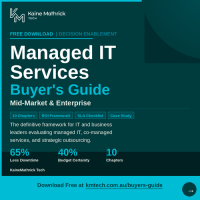
FREE DOWNLOAD
Managed IT Services Buyer's Guide
The 10-chapter framework for IT and business leaders. Includes ROI model, SLA checklist, and vendor evaluation guide.
Why Did These Organisations Choose Managed IT Services?
Managed IT services were selected to introduce:
- End‑to‑end accountability
- Proactive security management
- Predictable operating costs
- Structured governance and reporting
For regulated environments, the ability to align IT operations with frameworks such as ACSC Essential Eight and ISO 27001 was a key decision driver.
Related: Learn more about how KMTech’s helped a legal firm
How Was the Transition to Managed IT Services Implemented?
Successful transitions followed a consistent pattern:
- Environment and risk assessment
- Stabilisation of critical systems
- Security uplift and standardisation
- Introduction of governance and reporting
- Ongoing optimisation
This phased approach minimised disruption while delivering early operational wins.
Related: KMTech helps an enterprise healthcare provider with managed it services
What Security Improvements Were Achieved?
Managed IT services embedded compliance controls into daily operations rather than treating compliance as a project.
Outcomes included:
- Documented controls and evidence readiness
- Clear ownership of security responsibilities
- Improved alignment with APRA CPS 234 and Privacy Act expectations
This reduced regulatory exposure and executive stress
Related: Read about our NFP client transformation
What Operational Improvements Were Delivered?
Operational improvements consistently reported included:
- Faster issue resolution
- Reduced recurring IT incidents
- Improved system reliability
- Better support for hybrid and remote work
In several cases, managed services replaced fragmented vendor support with a single accountable partner.
Related: KMTech helps an enterprise healthcare provider with managed it services
How Did Managed IT Services Reduce Costs?
Cost benefits were realised through:
- Removal of legacy infrastructure
- Reduction in emergency remediation spend
- Lower reliance on ad‑hoc contractors
- Avoided hardware refresh costs
Some organisations achieved measurable annual savings while improving service quality and security posture
Related: Review how KMTech helped a client achieve ROI
How Did Executives Benefit from Managed IT Services?
Executives gained:
- Clear visibility of IT risk
- Regular performance and security reporting
- Confidence in compliance readiness
- Reduced board‑level technology concerns
IT became a governed business function rather than an ongoing operational risk.
How Did IT Leaders Benefit from Managed IT Services?
IT leaders reported:
- Less firefighting
- Access to specialist security expertise
- Improved system stability
- Capacity to focus on strategic initiatives
Managed services acted as an extension of the internal IT function rather than a replacement
Related: KMTech helps an enterprise healthcare provider with managed it services
What Made These Managed IT Engagements Successful?
Success factors included:
- Clear service scope and accountability
- Security‑first service design
- Strong governance and reporting
- Alignment between IT and business goals
Price alone was never the deciding factor in successful engagements.
Frequently Asked Questions
What types of organisations benefit most from managed IT services?
Organisations with regulatory obligations, multiple sites, or limited internal IT capacity.
Last updated:
Are managed IT services suitable for not‑for‑profits?
Yes. Many not‑for‑profits use managed services to reduce cost and risk without expanding headcount.
Last updated:
How long does it take to see results?
Operational improvements are often visible within the first 3–6 months.
Last updated:
Do managed IT services replace internal IT teams?
No. Many organisations use co‑managed models to extend internal capability.
Last updated:
How is success measured?
Through uptime, security posture, incident reduction, and executive reporting.
Last updated:
Are managed IT services scalable?
Yes. Services scale as organisations grow or change operating models.
Last updated:
How do managed IT services support compliance?
By embedding controls, documentation and reporting into everyday operations.
Last updated:
Is managed IT suitable for highly regulated industries?
Yes. It is increasingly essential for regulated sectors.
Last updated:
What Can Other Organisations Learn from These Case Studies?
Key lessons include:
- Reactive IT scales risk, not capability
- Security and compliance must be embedded, not bolted on
- Predictable IT operations support growth
- Governance is essential for executive confidence
These lessons apply across most mid‑market and enterprise environments.
Want to achieve similar outcomes in your organisation?
Request a Managed IT Readiness Assessment to understand risk, cost, and improvement opportunities in your environment.
More on Managed IT Services from KMTech
Everything on this topic, in one place.
ARTICLES
Last updated:


