

In-House vs Outsourced Cyber Security: A Decision Guide for Australian CISOs
Published on: March 22nd, 2023
Last edited: October 13th, 2026

Quick answer: In-house cyber security means employing your own security team. Outsourced cyber security means contracting a managed security service provider (MSSP) to monitor, detect and respond to threats for you. In-house gives the most control but is hard and expensive to staff around the clock. Outsourcing delivers 24/7 coverage and specialist skills faster. For most Australian mid-sized organisations, a co-managed model works best: an internal lead owns risk and governance while an MSSP runs day-to-day security operations.
Why This Decision Matters More Now
The threat picture in Australia has not eased. In its Annual Cyber Threat Report 2024-25, the Australian Signals Directorate (ASD) reported receiving over 84,700 cybercrime reports, one every six minutes, and responding to more than 1,200 cyber security incidents, up 11% on the previous year.
The cost per incident is also rising fastest for larger organisations. ASD reported the average self-reported cost of cybercrime per report as:
| Business size | Average cost per report (2024-25) | Change on 2023-24 |
|---|---|---|
| Small business | $56,600 | Up 14% |
| Medium business | $97,200 | Up 55% |
| Large business | $202,700 | Up 219% |
At the same time, reporting obligations have tightened. That changes the question from “can we afford a security team?” to “who is watching our environment at 2am, and can we prove it to a regulator?”
Cyber risk on the leadership agenda?
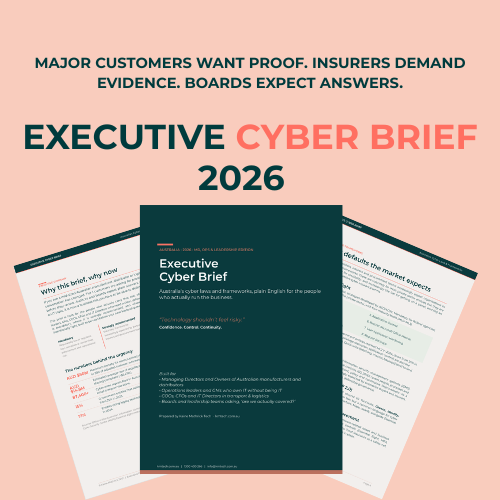
This Executive Cyber Brief is designed as a practical pre-read for MDs, GMs and Ops leaders before the next leadership meeting.
What Is In-House Cyber Security?
Outsourced cyber security means contracting an external provider to deliver some or all of those functions. The most common model is a managed security service provider (MSSP), which provides 24/7 monitoring through a security operations centre (SOC as a service), threat detection, incident response and compliance reporting under a service agreement. Outsourcing security is different from general IT outsourcing; see our guide to the differences between outsourcing and managed services.
What’s outsourced cybersecurity?
This phrase refers to hiring a third-party firm to manage your company’s cybersecurity functions. The outsourced provider offers a range of products and services, including threat detection, firewall management, and vulnerability assessment. Whatever you enjoy will depend on what you’ve paid for in your package.
Of course, external technicians can handle all cybersecurity-related tasks in your organization. However, keeping at least one person in your in-house team for a smoother flow of operations is always wise.
In-House vs Outsourced vs Co-Managed at a Glance
| Factor | In-house | Outsourced (MSSP) | Co-managed |
|---|---|---|---|
| Control | Full control of people, tools and process | Provider runs process to an agreed scope | You set policy and priorities; provider runs operations |
| 24/7 coverage | Needs a rostered team, not a single hire | Included through the provider's SOC | Included through the provider's SOC |
| Time to capability | Months: recruit, tool up, tune | Weeks: onboard to an existing SOC | Weeks, building on your existing team |
| Skills depth | Limited to the people you can hire | Access to a wider specialist bench | Internal context plus external depth |
| Cost profile | Salaries, tooling and training (largely fixed) | Predictable service fee | Smaller internal team plus service fee |
| Business context | Strongest | Weakest unless well onboarded | Strong, held by your internal lead |
| Accountability | Yours | Still yours | Still yours |
Pros and cons of in-house cybersecurity
Benefits
- Control: You decide the tools, the priorities and how incidents are handled, and you can change any of it quickly.
- Business context. Internal staff know which systems, clients and data matter most, so they triage alerts with less back-and-forth.
- Knowledge retention. Expertise builds inside the organisation instead of sitting with a supplier.
Disadvantages
- Hiring is hard. AustCyber has estimated Australia needs around 85,000 additional cyber security workers by 2030. Experienced analysts are scarce and expensive, and losing one person can leave a gap overnight.
- Around-the-clock coverage. Attacks do not keep business hours. Monitoring 24/7 means shifts, leave cover and on-call arrangements, which a small team struggles to sustain.
- Tooling cost. SIEM, EDR, threat intelligence and the effort to tune them sit on top of salaries.
- Narrower exposure. An internal team sees one environment. Providers see patterns across many, which helps them spot new attack techniques sooner.
Pros and cons of outsourced cybersecurity
Benefits
- 24/7 monitoring from day one. An MSSP’s SOC is already staffed and tooled, so coverage starts once onboarding is complete.
- Specialist depth. You get access to incident responders, threat hunters and compliance specialists you would not hire individually.
- Predictable cost. A service fee replaces recruitment, retention and tooling spend.
- Faster maturity. Providers bring tested playbooks aligned to frameworks such as the ACSC Essential Eight.
Risks and How to Manage Them
- Generic playbooks. A provider may apply standard procedures that miss your priorities. Manage it with a thorough onboarding that documents critical systems, data and escalation contacts.
- On-site response. Remote teams can be slower when hands-on work is needed. Confirm response times and on-site arrangements in the service agreement.
- Visibility and lock-in. Make sure you own your logs, receive regular reporting, and can exit the contract cleanly.
The Third Option: Co-Managed Cyber Security
Most organisations do not face a strict either/or choice. In a co-managed model, an internal IT or security lead keeps ownership of risk, policy and business context, while an MSSP provides the 24/7 SOC, detection and incident response. The internal lead acts as the bridge, so alerts are triaged with business knowledge and the provider’s team handles volume and out-of-hours response.
This suits organisations with an internal IT team that is stretched across operations and cannot add round-the-clock security on top. Download our co-managed executive guide to see how the responsibilities are split.
Outsourcing Does Not Outsource Accountability
Whichever model you choose, responsibility for protecting your data stays with your organisation. Several Australian obligations make this explicit:
- APRA CPS 234 and CPS 230. APRA-regulated entities remain accountable for information security even when it is managed by a third party, and must notify APRA of material information security incidents within 72 hours. CPS 230 adds requirements for managing material service providers.
- OAIC Notifiable Data Breaches scheme. Organisations covered by the Privacy Act must notify the OAIC and affected individuals of eligible data breaches. Your provider must be able to detect and evidence a breach quickly enough for you to assess it.
- Cyber Security Act 2024. Businesses with annual turnover over $3 million must report ransomware payments to ASD within 72 hours of making them.
- Legal practices. Law firms hold client trust money and privileged information. The Legal Practitioners’ Liability Committee (LPLC) publishes cyber risk guidance for Victorian firms, and insurers increasingly ask how monitoring is delivered.
Before signing with any provider, confirm how their reporting, response times and evidence will support each obligation that applies to you.
How to Decide: Six Questions
- Who monitors alerts outside business hours today? If the answer is “nobody”, outsourced or co-managed coverage is the priority.
- Can you hire and keep at least a small rostered team? If not, a fully in-house SOC is not realistic.
- Which regulators and contracts apply to you? List the reporting deadlines and check any provider can support them.
- How much business context does triage need? The more specialised your systems, the more you need an internal lead.
- What is your realistic budget? Compare the full cost of salaries, tooling and training against a service fee.
- Do you have an incident response plan? Whoever runs detection must be named in it. See our guide to incident response plans.
Choosing an Outsourced Provider
If you decide to outsource all or part of your security, compare providers on capability, transparency and response readiness rather than marketing claims. Our overview of the top cyber security companies in Australia is a useful starting shortlist, and our 15 tips for selecting the right cyber security provider covers the questions to ask before you sign.
The Verdict
A fully in-house security function makes sense for large organisations that can staff and fund a rostered team. Fully outsourced security suits organisations without internal security expertise that need 24/7 coverage quickly. For most Australian mid-sized firms, particularly in legal and financial services, co-managed security offers the best balance: internal ownership of risk and context, with an MSSP providing round-the-clock detection and response.
Frequently Asked Questions
We have a cyber incident right now and no in-house security team. What should we do first?
Call ASD’s Australian Cyber Security Hotline on 1300 CYBER1 (1300 292 371). Isolate affected devices from the network but do not wipe them, because logs and evidence are needed. Notify your cyber insurer, engage an incident response provider, and assess whether the incident is an eligible data breach under the OAIC Notifiable Data Breaches scheme.
Is outsourced cyber security cheaper than in-house?
Usually, for 24/7 coverage. Round-the-clock monitoring in-house needs several staff plus SIEM and EDR tooling. An MSSP spreads those costs across many clients. In-house can be cost-effective for organisations that only need business-hours security or already employ a large team.
Can we outsource cyber security and still meet APRA CPS 234?
Yes, but accountability stays with your board. CPS 234 requires you to assess the information security capability of third parties managing your information assets and to notify APRA of material incidents within 72 hours. Your provider’s reporting and response times must support those obligations.
What is the difference between an MSP and an MSSP?
A managed service provider (MSP) runs day-to-day IT such as support, devices and cloud. A managed security service provider (MSSP) specialises in security operations: 24/7 monitoring, threat detection and incident response. Read more in What is an MSSP?
What is co-managed cyber security?
Co-managed cyber security splits responsibility between your internal team and an MSSP. Your team owns policy, risk and business context; the provider runs the SOC, detection and response. It suits organisations with internal IT staff who cannot cover security 24/7.
How do we evaluate an MSSP?
Check 24/7 SOC coverage, documented response times, Essential Eight alignment, reporting that supports your regulatory obligations, log ownership, and clear exit terms. Ask for references from organisations in your industry. Our 15 tips for selecting a cyber security provider covers this in detail.
Conclusion
In-house cybersecurity involves hiring internal staff to handle cybersecurity functions. A third-party company comes in if you choose to go with outsourced cybersecurity. Both have their pros and cons, and it all depends on what works for your company. As such, you must consider your business size and demands to decide which one to employ in your organization.
Not Sure Which Model Fits?
Book a cyber security audit and we will map your current coverage, obligations and gaps, then recommend an in-house, outsourced or co-managed approach.
Last updated:


