

Quick answer: An MSSP (managed security service provider) is a specialist company that monitors, manages and responds to cyber threats on your behalf, usually 24/7 from a security operations centre (SOC). Unlike an MSP, which runs your day-to-day IT, an MSSP focuses only on security: threat detection and response, security tooling, vulnerability management and compliance support. Most MSSPs charge a monthly fee per user, per device or per service tier.
What is an MSSP?
A managed security service provider is an outsourced security team. It takes ongoing responsibility for protecting your systems, data and people, rather than selling you a tool and leaving you to run it. The MSSP supplies the people (security analysts and engineers), the process (monitoring, triage and incident response playbooks) and the technology (security platforms, threat intelligence and reporting).
For most mid-sized Australian organisations, an MSSP is the practical alternative to building an in-house security operations centre, which needs specialist staff on rosters around the clock.
Cyber risk on the leadership agenda?
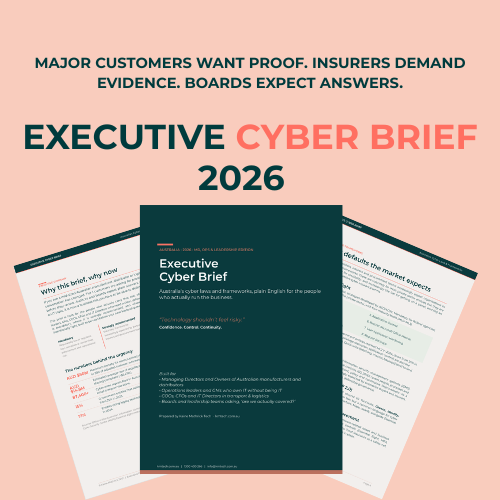
This Executive Cyber Brief is designed as a practical pre-read for MDs, GMs and Ops leaders before the next leadership meeting.
What does an MSSP do?
Day to day, an MSSP works in a continuous cycle:
- Monitor: collects and watches security signals from endpoints, networks, cloud platforms, email and identity systems.
- Detect and triage: separates genuine threats from noise, so your team isn’t buried in alerts.
- Respond: contains threats, for example by isolating a compromised device or disabling a compromised account, within agreed authority and service levels.
- Report: gives IT leaders and boards clear reporting on incidents, risk and maturity.
- Improve: closes gaps found along the way, such as unpatched systems, weak access controls or missing logging.
What services do MSSPs typically provide?
Service catalogues vary, but most MSSPs offer a combination of the following:
- 24/7 security monitoring and a security operations centre (SOC) (SOC as a service)
- Managed detection and response (MDR) and endpoint detection and response (EDR) (managed detection and response)
- SIEM management: collecting and correlating logs to spot attacks (managed SIEM)
- Vulnerability management and patching oversight
- Managed firewall and network security
- Identity and access management, including multi-factor authentication
- Email and Microsoft 365 security
- Security awareness training for staff (security awareness training)
- Incident response (cyber incident response)
- Compliance support against the Essential Eight, ISO 27001, the Privacy Act and APRA CPS 234
- Dark web monitoring for leaked credentials
MSSP vs MSP vs MDR: What's the Difference?
The three are often confused. The short version: an MSP keeps your IT running, an MSSP keeps it secure, and an MDR provider specialises in one part of security, detecting and responding to active threats.
| MSP | MSSP | MDR provider | |
|---|---|---|---|
| Main focus | Day-to-day IT operations | Security across the whole environment | Threat detection and response |
| Typical services | Help desk, devices, cloud, networks, backups | Monitoring, SOC, MDR, vulnerability management, security tooling, compliance support | 24/7 detection, investigation and containment |
| Security monitoring | Basic or none | Continuous, usually 24/7 | Continuous, 24/7 |
| Acts on threats | Rarely | Yes, within agreed authority | Yes, often immediately |
| Best for | Organisations needing reliable IT support | Organisations needing an outsourced security function | Organisations with security tools but no 24/7 response capability |
Many organisations use more than one. KMTech, for example, runs managed IT services and managed security services as separate offerings, so clients can take one, the other or both. For a general overview of MSPs, see what a managed service provider does.
What Is a SOC and Why Does It Matter?
A security operations centre (SOC) is the team, process and technology that watches for and responds to threats. Attacks don’t keep business hours, and a breach that starts on a Friday night can spread for days before anyone notices. A SOC closes that gap. Most MSSPs deliver their monitoring through a SOC, which is why the two terms often appear together. Read more in SOC as a service: the ultimate guide.
How Much Does an MSSP Cost?
MSSP pricing depends on the size of your environment, the services included and how much responsibility you hand over. Most providers use one of six pricing models, or a mix of them.
| Pricing model | How it works | Suits |
|---|---|---|
| Per user | A monthly fee for each staff member covered | Organisations where most risk sits with people and their devices |
| Per device or endpoint | A monthly fee for each laptop, server or network device monitored | Environments with many servers or shared devices |
| Tiered packages | Bundled service levels (for example, essentials, standard, premium) at a fixed monthly price | Organisations wanting predictable costs |
| Per service (à la carte) | Individual services priced separately, such as MDR only or SIEM only | Organisations filling specific gaps |
| Co-managed | The MSSP covers defined functions (often 24/7 monitoring and response) alongside your internal IT team | Organisations with in-house IT but no security operations |
| Project-based | A fixed quote for one-off work such as audits, penetration tests or compliance assessments | Point-in-time needs before or alongside an ongoing service |
What Drives the Price
- Number of users, devices and locations
- Monitoring hours: business hours or 24/7
- Response authority: alert-only, or the MSSP acts on threats
- Log volume and the number of systems connected to the SIEM
- Compliance scope, such as Essential Eight maturity targets, ISO 27001 or APRA CPS 234 reporting
- Onboarding effort, including remediation needed before monitoring starts
How to Compare MSSP Quotes
Quotes are rarely like for like. Before comparing price, check each one states: what is monitored, the response actions included, response-time commitments, what counts as an incident, reporting frequency, and what costs extra (incident response hours, onboarding and offboarding).
It also helps to compare total cost against the cost of an incident. The Australian Signals Directorate’s Annual Cyber Threat Report 2024–25 puts the average self-reported cost of cybercrime per report at $56,600 for small businesses, $97,200 for medium businesses and $202,700 for large businesses.
When Should a Business Use an MSSP?
An MSSP is usually the right move when one or more of these is true:
- You have no one watching for threats outside business hours.
- Your IT team is stretched across support and projects, with no dedicated security capability.
- You have compliance obligations, such as the Notifiable Data Breaches scheme administered by the OAIC, or APRA CPS 234 for regulated financial institutions (Australian cyber security compliance guide)
- Your cyber insurer, clients or board are asking for evidence of controls such as the Essential Eight.
- You hold sensitive client data, as law firms and financial services firms do.
Are MSSPs Worth It?
For most mid-sized organisations, yes. Running an in-house SOC 24/7 means hiring and retaining several specialist analysts, licensing security platforms and keeping both current. An MSSP spreads those costs across many clients and gives you access to broader threat intelligence. The trade-off is less direct control, which is why scope, response authority and reporting need to be clear from the start. For a detailed comparison, read in-house vs outsourced cyber security.
How to Choose the Right MSSP
Look for an MSSP that can show:
- 24/7 monitoring with real response authority, not just alert forwarding.
- Clear service levels for detection, response and escalation.
- Alignment with Australian frameworks, including the ASD Essential Eight, the Privacy Act and, where relevant, APRA CPS 234.
- Recognised certifications, such as ISO 27001, and transparency about where your data is stored.
- Board-ready reporting that shows risk and maturity trends, not just ticket counts.
- Flexibility to co-manage alongside your internal IT team.
- A clear onboarding and exit plan, so you are never locked in.
For the full checklist, read 15 tips for selecting the right cyber security provider, or compare providers in top cyber security companies in Australia.
How KMTech Delivers Managed Security
KMTech provides managed security services as a standalone service, separate from managed IT. Essential Eight Maturity Level 2 is the baseline across our managed service. For organisations with their own IT team, services such as MDR, security awareness training and Shadow AI governance can be co-managed, with technical support and escalations handled by our SOC team.
Key Takeaway
An MSSP gives you a dedicated security team without building one. Choose one on response capability, transparency and fit with your compliance obligations, then compare price on a like-for-like scope.
Frequently Asked Questions
We think we’ve had a breach and don’t have an MSSP. What should we do right now?
Isolate affected devices from the network but don’t switch them off or wipe them, as they hold evidence. Call ASD’s Australian Cyber Security Hotline on 1300 CYBER1 (1300 292 371) and report the incident through ReportCyber. Notify your cyber insurer early. If personal information may be involved, assess the breach under the Notifiable Data Breaches scheme (the OAIC expects this within 30 days). APRA-regulated entities must notify APRA within 72 hours of becoming aware of a material information security incident.
What is the difference between an MSP and an MSSP?
An MSP (managed service provider) runs day-to-day IT, such as the help desk, devices, cloud platforms and networks. An MSSP (managed security service provider) specialises in security: 24/7 monitoring, threat detection and response, vulnerability management and compliance support.
How much does an MSSP cost in Australia?
It depends on the number of users and devices, the services included, monitoring hours and how much response authority the MSSP has. Most MSSPs charge a monthly fee per user, per device or per service tier, with one-off work such as audits quoted separately.
Is an MSSP the same as MDR?
No. Managed detection and response (MDR) is one service focused on detecting and containing active threats. An MSSP usually offers MDR alongside a broader set of services, such as SIEM, vulnerability management, security tooling and compliance support.
Do we still need internal IT staff if we use an MSSP?
Usually, yes. An MSSP handles security monitoring and response, while day-to-day IT support still needs an internal team or an MSP. Many organisations co-manage, with the MSSP covering security operations and internal IT covering everything else.
Can an MSSP help with Essential Eight or ISO 27001 compliance?
Yes. A good MSSP will assess your current maturity, implement and monitor the required controls, and provide the evidence auditors, insurers and boards ask for. Essential Eight is published by ASD; ISO 27001 is an international standard for information security management.
Improve Your Cyber Posture With KMT
Not sure where your gaps are? Book a cyber security audit or download the Cyber Risk Executive Brief to take to your next leadership meeting.
Last updated:
