

Why DeepSeek Is a Dangerous Choice for Australian Businesses — And Why KMT Says “No”
Published on: May 19th, 2025
Last edited: September 18th, 2026

There are as many reasons to be excited about artificial intelligence’s (AI) growing role in shaping the digital workplace as reasons to be fearful. On one hand, the technology is capable of fulfilling repetitive but crucial tasks for long hours without suffering fatigue. On the other hand, it’s replacing countless jobs, some of which require human intelligence.
In the ever-evolving world of artificial intelligence, new tools emerge almost daily, promising to revolutionise how we work, communicate, and innovate. But not all AI is created equal — and some come with risks that far outweigh their benefits.
One such tool is DeepSeek, a Chinese-developed AI platform that has rapidly gained attention for its powerful capabilities. But behind the hype lies a growing body of concern — from cybersecurity experts, government agencies, and global thought leaders — about the platform’s potential to compromise data sovereignty, national security, and enterprise trust.
Regardless of your stand on the matter (or on any AI-related issue), AI in the workplace is inevitable. McKinsey Global Institute’s latest survey on AI-driven automation reported that 92% of companies plan to increase their investment in generative AI within the next three years. Among those who are already doing so, only 1% believe their investments in workplace AI have reached maturity.
At Kaine Mathrick Tech, we believe in the transformative power of AI — but we also believe in responsible innovation. That’s why we’re taking a clear stance: DeepSeek is not safe for Australian businesses, and we do not support its use in any form across our managed services, client environments, or internal operations.
Here’s why.
1. Government and Industry Warnings: A Red Flag You Can’t Ignore
The alarm bells around DeepSeek aren’t just coming from fringe commentators — they’re coming from the highest levels of government and cybersecurity leadership.
In February 2025, leading Australian cybersecurity firm CyberCX formally recommended that DeepSeek be restricted for use in government and critical infrastructure sectors.
. This followed a series of escalating actions:
- An NSW government department became the first to ban DeepSeek outright.
- The federal government soon followed, banning DeepSeek from all government devices
- Other countries, including Taiwan, have also implemented bans due to concerns over data collection and national security.
These aren’t isolated moves — they reflect a growing consensus that DeepSeek poses a systemic risk to sensitive data and operational integrity.
“Several Australian ministers have warned against sharing personal information with the new, popular artificial intelligence (AI) model from China, DeepSeek.”
—
2. Data Sovereignty and Privacy: Who Really Owns Your Data?
One of the most pressing concerns about DeepSeek is where — and how — your data is stored.
According to a BBC investigation cited in internal KMT communications, DeepSeek collects extensive personal and technical data, including user input, device information, and even keystroke patterns. All of this is stored on servers located in China.
This raises serious questions for Australian businesses:
- Data sovereignty: Are you inadvertently exposing sensitive or regulated data to foreign jurisdictions?
- Transparency: Who has access to your data? How long is it retained? What is it used for?
- Compliance: Are you breaching Australian privacy laws or industry-specific regulations by using DeepSeek?
In a world where data is currency, handing over your digital assets to an opaque foreign platform is a gamble no business should take.
3. AI as a Double-Edged Sword: Insights from McKinsey and PwC
Global consulting leaders are also weighing in on the risks of AI platforms like DeepSeek.
In a recent McKinsey blog, cybersecurity experts warned that AI is now both the greatest threat and the greatest defence in cybersecurity. The speed and scale at which AI can be used to launch attacks — from deepfakes to spear phishing — is unprecedented.
“AI is accelerating the speed of cyberattacks… Social engineering tactics, such as impersonation and spear phishing, have become more effective, making it increasingly difficult for organisations to identify and prevent these threats.”
— McKinsey & Company
PwC echoes this sentiment, urging organisations to revamp their cyber, data, and privacy protections in light of generative AI risks. Their guidance includes:
- Establishing escalation frameworks for AI-related incidents
- Prioritising sensitive-data scanning and vulnerability monitoring
- Ensuring AI governance is embedded into enterprise risk management
These are not theoretical concerns — they are urgent imperatives for any business using AI tools in 2025.
4. The KMT Perspective: Why We Say “No” to DeepSeek
At Kaine Mathrick Tech, we’ve built our reputation on being the human face of tech — and that means putting people, privacy, and protection first.
We’ve seen firsthand how AI can empower businesses — from predictive analytics to smart automation — but only when it’s deployed responsibly. DeepSeek fails that test.
Our internal resources, including the ACSC Essential Eight , emphasise the importance of:
- Endpoint protection and threat detection
- Data sovereignty and compliance with ACSC Essential Eight
- Proactive risk management and incident response planning
DeepSeek undermines these principles by introducing opaque data flows, foreign jurisdiction risks, and a lack of accountability.
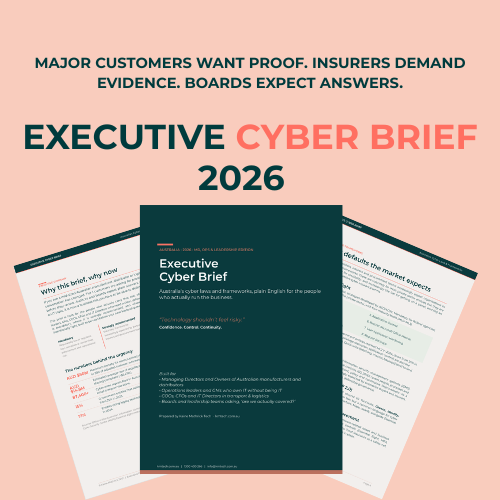
Cyber risk on the leadership agenda?
This Executive Cyber Brief is designed as a practical pre-read for MDs, GMs and Ops leaders before the next leadership meeting.
5. Real-World Implications: What’s at Stake for Australian Businesses
The risks of using DeepSeek aren’t just theoretical — they’re already playing out in the real world.
- Cyber incidents are rising: Three-quarters of Australian businesses expect to face a cyber breach in 2025.
- Healthcare and education sectors are under siege: From ransomware attacks to data leaks, the consequences of poor cyber hygiene are devastating.
- Trust is fragile: Once lost, customer trust is hard to regain — and using a platform like DeepSeek could be seen as a breach of that trust.
In a recent podcast episode, Cyber Daily journalists discussed how DeepSeek’s rise has coincided with a wave of AI-related cyber threats, including deepfakes, data leaks, and even AI-powered scams.
6. What You Can Do: KMT’s Recommendations
If you’re a business leader, IT manager, or compliance officer, here’s what we recommend:
a. Audit Your AI Stack
Review all AI tools currently in use across your organisation. Identify any that rely on foreign data centres or lack clear privacy policies.
b. Update Your Acceptable Use Policies
Explicitly prohibit the use of DeepSeek and similar platforms in your internal policies. Communicate this clearly to staff.
c. Partner with Trusted Providers
Work with Australian-based cybersecurity experts who understand local regulations, threat landscapes, and compliance frameworks. Our guide outlines how local partnerships can enhance resilience.
d. Educate Your Team
Run regular cybersecurity awareness training to help staff recognise phishing attempts, social engineering tactics, and risky AI behaviours.
7. Final Thoughts: The Human Face of Responsible AI
At KMT, we believe in the power of technology to transform — but only when it’s used ethically, transparently, and securely.
DeepSeek may offer flashy features and short-term gains, but the long-term risks are too great. From national security concerns to data sovereignty violations, the evidence is clear: this is not a platform Australian businesses should trust.
We’re proud to take a stand — not just for our clients, but for the broader business community. Because cybersecurity isn’t just an IT issue — it’s a leadership issue. And leadership means making the hard calls, even when they’re unpopular.
If you’d like help auditing your AI tools, updating your policies, or strengthening your cybersecurity posture, we’re here to help.
Let’s build a safer, smarter, and more sovereign digital future — together.
Last updated:


